Cat vomiting: when it's normal and when food is the cause
A cat that throws up a hairball now and then, especially when the seasons change, is usually nothing to worry about. If instead it vomits often, even without hairballs, and you also notice soft stools, a dull coat or itching, one of the first things to check is the food bowl. In this article we look at how to tell the two situations apart, which signs point to a food sensitivity and when it's time to call the vet.
If you've just cleaned the rug for the third time this week, you're in the right place. Vomiting is one of the most common reasons owners worry about their cat, and understanding where it comes from is the first step to helping.
Vomiting or regurgitation: what's the difference?
First, it helps to understand what you're seeing. Regurgitation is passive: the cat lowers its head and the food comes out almost whole, without effort, often a few minutes after eating. Vomiting is active: the cat contracts, makes retching noises, and what comes up can contain partly digested food, liquid or foam. This distinction helps your vet, so make a note of it.
When is it normal for a cat to vomit?
In some situations an occasional episode is no cause for alarm:
- Hairballs. Cats groom themselves and swallow hair, which is normally passed in the stool. Sometimes, though, it can build up in the stomach and come back up. This happens more often when the seasons change, when cats naturally shed more, and in long-haired cats.
- It ate too fast. Eating quickly can lead to vomiting or regurgitation right after a meal, sometimes with kibble still whole. It's common in multi-cat homes, where cats gulp their food "in competition".
- It ate grass. Many cats chew grass and then bring it back up.
In these cases, right afterwards the cat goes back to eating, playing and behaving as usual.
When is food the cause?
If vomiting becomes a habit, diet is one of the first things to look at. These signs, especially when they appear together, suggest a food or digestive sensitivity:
- it vomits often, even without hairballs;
- it has soft or irregular stools;
- the problem started after a change of kibble, perhaps made overnight;
- the coat is dull or the cat scratches more than usual.
How you change food matters too: switching abruptly from one kibble to another is a common cause of an upset stomach, even with a good-quality food.
When should you take your cat to the vet?
Don't wait, call the vet if:
- it vomits several times in the same day or the vomiting lasts more than a day;
- there is blood or dark material in the vomit;
- it isn't eating or drinking, or seems lethargic;
- the vomiting comes with diarrhoea or weight loss;
- it's a kitten, a senior cat or already has a known condition;
- it retches hard and repeatedly without bringing anything up;
- you suspect it has swallowed something inedible, a plant or a toxic substance.
Diet helps manage a sensitive stomach, but it doesn't replace a vet visit when symptoms are significant.
What to put in the bowl of a cat with a sensitive stomach?
For a cat with food or digestive sensitivities, three things matter: easily digestible (and therefore high-quality) protein, a protein source that doesn't cause problems, and fibre to support the gut.

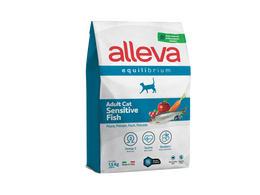
Alleva Equilibrium Sensitive is formulated for adult cats, neutered or not, with food or digestive sensitivities. In the Ocean Fish recipe you'll find:
- high-quality, highly digestible fish, a suitable choice for cats with food sensitivities;
- soluble fibre from apple and carrot, which support a healthy gut microbiota;
- omega-3 and omega-6, for a shiny, healthy coat;
- taurine for heart health and L-carnitine for fat metabolism;
- blueberry and cranberry as a source of antioxidants;
- DL-methionine and controlled magnesium for urinary well-being.
If your cat doesn't tolerate fish, Equilibrium Sensitive is also available with rabbit, duck and venison: different protein sources to find the right one for your cat.
How to change kibble without upsetting the stomach?
Make the switch gradually, over about 7 days:
| Days | Old food | New food |
|---|---|---|
| 1–2 | 75% | 25% |
| 3–4 | 50% | 50% |
| 5–6 | 25% | 75% |
| 7 | 0% | 100% |
This schedule generally works, but some cats, especially creatures of habit, may need longer to adapt, even two weeks or more. It's important to respect each cat's pace without forcing the change.
If the cat vomits or has soft stools during the transition, slow down: stay a few more days on the previous ratio. If the symptoms don't go away, talk to your vet.
A few habits that help
- Smaller, more frequent meals instead of one or two large ones.
- A slow-feeder bowl or some kibble in a puzzle toy, if it eats too fast.
- Brush it often, especially when the seasons change and for long-haired cats: less hair swallowed, fewer hairballs.
- Fresh water always available, away from the food bowl.
Frequently asked questions
Why is my cat vomiting white foam?
It often happens on an empty stomach or when the cat is trying to bring up a hairball. If it's rare and the cat is fine, it's usually not serious; if it keeps happening or the cat seems lethargic, talk to your vet.
My cat throws up its kibble right after eating: what does it mean?
If the kibble comes up whole shortly after a meal, the cat has often eaten too fast. Try smaller meals and a slow-feeder bowl.
How often is it normal for a cat to vomit?
There's no number that applies to every cat: an occasional hairball is normal. If vomiting becomes frequent or the cat's behaviour changes, talk to your vet.
Can changing kibble make a cat vomit?
Yes, if the change is sudden. That's why it's best to switch to the new food over at least 7 days, mixing it with the old one.
Which kibble should I choose for a cat with a sensitive stomach?
Look for highly digestible protein, a single main protein source your cat tolerates and fibre for the gut. Alleva Equilibrium Sensitive is made for this, in four flavours: ocean fish, rabbit, duck and venison.