Kidney Failure in Cats: Causes, Symptoms, and Nutritional Management
When the kidneys can no longer function properly, the body begins to accumulate waste products and loses some of its ability to maintain a stable internal balance. This is when we speak of kidney failure in cats.
The problem doesn't always present itself in the same way. In some cases, it appears suddenly; in others, it develops gradually over time. This also has a significant impact on how it is managed.
Understanding what happens physiologically helps us interpret symptoms more accurately and make informed decisions, especially when it comes to diet, which remains one of the most important factors in the day-to-day management of this condition.
Kidney failure in cats: what does it mean?
The kidneys perform several essential functions:
- filter the blood;
- eliminate waste products through urine;
- help maintain a stable balance of fluids and minerals in the body.
When this function declines, the system begins to lose efficiency. Substances that would normally be eliminated, such as urea and creatinine, tend to build up in the blood.
At the same time, the body struggles to properly regulate water and electrolytes. This can affect various physiological balances, not just at the renal level. So, it is not merely a matter of an organ functioning less effectively, but of a system that progressively loses its ability to maintain internal stability.
Acute Kidney Injury vs. Chronic Kidney Disease: Clinical Differences
Not all cases of kidney failure follow the same course. There are situations where the problem appears suddenly: the cat is fine, then something changes within a short time. This can happen afteringestion of a toxic substance, following an infection, or due to a significant imbalance. In these cases, we refer to an acute form. If action is taken quickly, it is possible to at least partially restore kidney function.
On the other hand, there is the chronicle chronic, which develops slowly, often without obvious signs at first. The cat carries on with its life, adapting and compensating. Until it can no longer do so.
By the time symptoms become apparent, the kidney has already lost a significant portion of its function. This is where the approach changes: it is not a matter of turning back the clock, but of managing a balance that has shifted.
Causes of kidney failure in cats
In cats, kidney failure (especially chronic kidney failure) is often the result of multiple factors that accumulate over time. The main ones include:
- Age Advanced age: as we age, kidney function tends to decline progressively;
- Urinary infections and problems: recurrent or improperly managed episodes can contribute to damage to kidney tissue;
- Toxic substances: ingestion of certain substances can have a direct impact on kidney function, especially in acute cases;
- Inflammatory conditions: Chronic inflammatory processes can compromise kidney structure over time;
- Individual predisposition: Some cats may be more susceptible than others to developing the condition.
See also the article "Cats Living Together: How to Help Them Live in Harmony."

Symptoms of kidney failure in cats
The most common symptoms include:
- Increased thirst: the cat drinks more than usual;
- Increased urine output: the litter gets soiled more often;
- Weight loss: even without noticeable changes in diet;
- Loss of appetite: the cat eats less or irregularly;
- Vomiting: episodes of varying frequency;
- Apathy: less activity, less interest in one's surroundings.
Diagnosis
The starting point is the veterinarian, who assesses the clinical picture and decides which tests to perform. Among the most commonly used are:
- Blood tests: these measure parameters such as creatinine and urea, which are indicators of kidney function;
- Urinalysis: helps determine how well the kidneys are functioning and assess urine concentration;
- Blood Pressure Measurement: High blood pressure is a very common consequence due to the close connection between the kidneys and the heart;
- Abdominal ultrasound: By placing an ultrasound probe on the abdomen, the veterinarian can visualize the kidneys and any physical abnormalities affecting them.
NoteNote: The diagnosis is based on all of these factors. Depending on the results, in cases of chronic disease, the condition may be assigned a severity stage (called “IRIS”) ranging from 1 (the mildest) to 4 (the most severe).
The Role of Nutrition in Kidney Failure in Cats
In these situations, diet is a key part of managing the condition. When kidney function declines, the kidneys have difficulty eliminating certain substances (including byproducts of protein metabolism and phosphorus).
👉 Nutrition helps adjust the diet to reduce metabolic load while still maintaining adequate nutritional intake.
In this context, a properly formulated diet includes:
- high-quality high-quality protein, in controlled amounts;
- phosphorus reduced, to limit accumulation;
- adequate energy intaketo prevent weight loss;
- nutritional balance, to support the body over time;
- Omega-3 and antioxidants: to protect kidney cells.
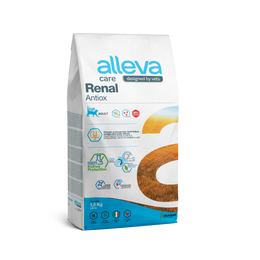
Solutions such as Alleva Care are developed with a targeted nutritional profile, designed to support the long-term management of the condition. Thanks to its balanced composition enriched with functional nutrients, it helps reduce the burden on the kidneys, improve the animal’s well-being, and limit the formation of oxalate and urate stones.
Daily Care for Cats with Kidney Failure
Day-to-day management consists of small, simple yet consistent steps.
- Always have water available: Keep several bowls around the house, preferably away from food. Water fountains can help encourage your cat to drink more;
- Small, frequent meals: it’s best to divide your daily food intake into several smaller meals, especially if your appetite is reduced;
- Don't change your diet suddenly: if you introduce a specific food, do so gradually;
- Monitor your weight: Even gradual weight loss is a sign that should not be ignored;
- Pay attention to your habits: drinking more, eating less, changing habits—these are all useful signs;
- Follow veterinary checks: they are used to adjust management over time, not just to “check the numbers.”
Management built over time
Kidney failure in cats is a condition that requires long-term management. There is no single solution, but a balance that must be maintained day after day, between diet, monitoring, and paying attention to the cat’s signs.
Nutrition nutrition, in this context, becomes a concrete to to help manage it in a more stable and sustainable way.
🐕 Check out Alleva Care dog food in our online store
📲 Follow us on social media to stay up to date on the latest news!
Frequently Asked Questions
What should a cat with kidney failure avoid eating?
It’s best to avoid foods high in phosphorus and low-quality protein. Unbalanced snacks or non-prescription food can also put extra strain on the kidneys.
How does a cat with kidney failure behave?
It often drinks more, urinates more frequently, and may eat less. It may seem calmer, less active, or lose weight over time.
How can you help a cat with kidney failure?
Through consistent care: a special diet, water available at all times, regular meals, and periodic veterinary checkups.
Why do cats develop kidney failure?
There can be various causes. Age is one of the main factors, but infections, toxins, or individual predisposition can also play a role.
How much water should a cat with kidney failure drink?
There is no one-size-fits-all answer. In general, a cat with kidney failure tends to drink more. The important thing is to always have fresh water available and to ensure adequate hydration.